

Every child has something to say
Supporting children who are not talking yet.
If your child is minimally speaking, non-speaking, or using only a few words, communication is still happening.
We help families build meaningful communication through connection, play, AAC, gestures, modelling, and everyday routines.

Communication begins long before first words
Talking is only one way children communicate.
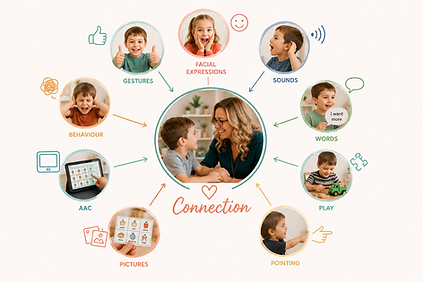
Before children speak, they are already communicating through:
✓ Looking
✓ Reaching
✓ Gestures
✓ Facial expressions
✓ Sounds
✓ Movement
✓ Behaviour
✓ Play
✓ AAC
Every communication attempt deserves to be noticed and responded to.
What does "not talking yet" mean?
Some children:
• use no spoken words
• use only a few words
• communicate through gestures
• use sounds
• point
• bring adults to things
• use pictures
• use AAC
Every child starts somewhere.
Our goal isn't simply to teach words.
Our goal is to build meaningful communication.
What skills come before talking?

Small note:
Communication grows one interaction at a time.
Sometimes the biggest progress isn't a new word. It's a shared smile, a point, a look, or asking for help.

Communication happens all day long.

AAC gives children another way to communicate
AAC isn't giving up on speech.
AAC gives children a reliable way to:
❤️ ask
❤️ comment
❤️ joke
❤️ protest
❤️ greet
❤️ share ideas
❤️ make choices
❤️ tell stories
❤️ talk about feelings
❤️ connect with others

What therapy looks like
ASSESSMENT

Understanding how your child communicates today.

PLAY-BASED
THERAPY

Communication through motivating activities

PARENT COACHING

Helping you create communication opportunities at home.


Communication during routines that already happen.

What communication might look like:
A child may learn to:
✓ Look toward another person
✓ Take turns
✓ Point
✓ Request
✓ Ask for help
✓ Make choices
✓ Comment
✓ Share excitement
✓ Answer questions
✓ Tell stories
✓ Use words
✓ Use AAC
Every child follows a unique path.
Progress is measured by meaningful participation—not by comparing children.

Frequently asked questions:
When should my child start therapy?
Therapy can be beneficial at any stage, as long as it is logistically realistic for you and your family. Ideally, as soon as your child doesn't hit the communication milestones (generally speaking single words by 1 year of age, and putting 2 words together by their second birthday), getting support from a speech-language pathologist on next steps and how to optimize their communication will get the best results.
Should we wait and see?
This is never a good plan, unless it is your only option (public SLPs are waitlisted and private therapy isn't accessible financially). Only positive change can happen when meeting your child where they are at, and supporting them through to the next step.
Will AAC stop my child from talking?
Absolutely not. This is a myth. Evidence and practice show it actually increases the amount your child talks as it reduces the pressure of communication on their words alone. Speaking, when available to the child, will always be their go-to. It requires the least amount of tools. If, however, for one reason or another speaking is too difficult (tired, oral motor speech difficulties, mouth can’t keep up with the brain’s though process, language and putting words into a sentence, super frustrated for eg), having AAC accessible allows them a tool to communicate their wants, needs, comments, requests, jokes, etc., as without it, they wouldn’t be able to in that moment. Every child deserves a right to communicate what they want to.
How many words should my child have?
Ideally, your child should be saying a few single words by their first birthday, and know enough words that they can start putting two words together by their second birthday.
What if my child only points?
That is still intentional communication. They could be pointing to have something labeled, because they want it, want to talk about it, etc. Interpreting what they are trying to say and model that verbally and with a tool like AAC is best practice.
My child doesn't imitate. Can they still learn?
Absolutely. As a parent, you know your child best. Interpret the things they want, and model (with a verbal words and AAC) how they could communicate that. Also, as shown above, there are steps to communication. Continuing to engage in fun songs and physical play games that can promote imitation, are a great place to start.
How can I help at home?
As a parent, you know your child best. Interpret the things they want, and model (with a verbal words and AAC) how they could communicate that. Also, as shown above, there are steps to communication. Continuing to engage in the fun activities or actions, or physical play games that you already do, and add one or two words to it.